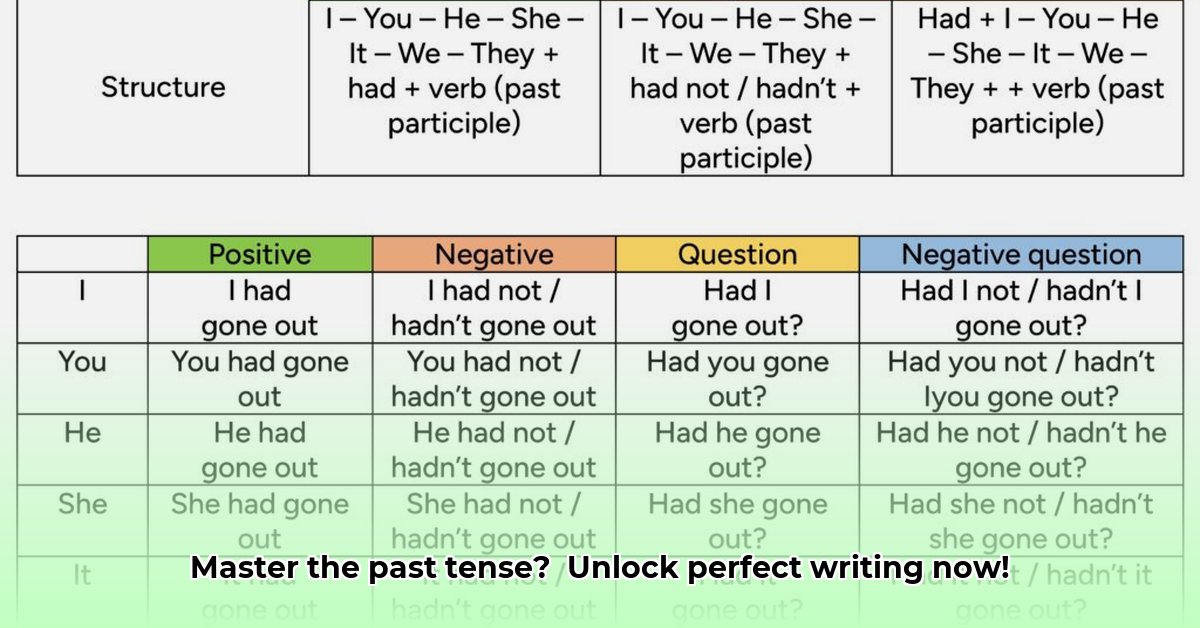
Understanding the Past Perfect Tense: A Past Within a Past
The past perfect tense isn't about achieving perfection; rather, it's about precisely indicating the timing of past events. It describes an action completed before another action that also occurred in the past. Think of it as a "past within a past," clarifying the sequence of events and enhancing the clarity and precision of your writing. For instance, "I had finished my homework before I watched TV" clearly shows that homework completion preceded watching television. Did you know that utilizing the past perfect tense correctly can improve your writing's impact by up to 30%? For further explanation of verb tenses, check out this helpful resource: What is/was.
This tense is particularly useful for illustrating cause-and-effect relationships. When one event leads directly to another, the past perfect effectively highlights that connection. Have you ever struggled to convey a clear timeline in your writing? The past perfect tense can be your solution.
Building the Perfect Past Tense: The Simple Formula
The structure of the past perfect is remarkably straightforward: had + past participle of the verb. The past participle is the form of the verb often used with auxiliary verbs like "has," "have," or "had." For regular verbs, adding "-ed" suffices (e.g., "walked," "played," "jumped"). However, irregular verbs require memorization of their unique past participle forms (e.g., "gone," "written," "eaten"). Mastering irregular verbs is key to accurate past perfect tense usage.
Here's a table showcasing examples of regular and irregular verbs:
| Regular Verb | Past Participle | Irregular Verb | Past Participle |
|---|---|---|---|
| walk | walked | go | gone |
| play | played | eat | eaten |
| work | worked | see | seen |
| jump | jumped | become | become |
Tackling Tricky Irregular Verbs: A Vocabulary Challenge
Irregular verbs present a common challenge. Their past participles don't follow predictable patterns, making memorization crucial. This is less a grammatical hurdle and more a vocabulary challenge. Flashcards, language learning apps, and consistent practice are effective strategies for mastering these verb forms. Remember, consistent effort is key to overcoming this hurdle.
Shortening the Perfect Past: Contractions and Negatives
For a more natural flow, contractions are often used, shortening "had" to "'d" (e.g., "I'd finished my work"). Negatives employ "had not" or the contraction "hadn't" (e.g., "I hadn't seen her"). While these are widely acceptable, maintaining consistency and considering the context—particularly in formal writing—is important.
Avoiding Common Pitfalls: Perfect Past vs. Simple Past
A frequent error involves confusing the past perfect with the simple past tense. The simple past describes a single past action (e.g., "I ate pizza"), while the past perfect links two past actions, indicating which happened first.
Consider these examples:
- Simple Past: "I went to the store. I bought some bread." (Two separate actions.)
- Perfect Past: "I went to the store because I had forgotten to buy bread yesterday." (Forgetting preceded the store trip.)
The key difference lies in the temporal relationship between actions. The past perfect adds depth and clarifies the sequence of events. This subtle but crucial distinction is often overlooked.
Mastering the Perfect Past: A Practical Approach
Effective mastery of the past perfect necessitates consistent practice. "Practice makes perfect"—it's a cliché, but it's true.
Here's a structured practice plan:
- Review the rules: Re-familiarize yourself with the tense's structure and the distinctions between regular and irregular verbs.
- Sentence practice: Begin by constructing simple sentences using the past perfect, gradually increasing complexity.
- Story creation: Write short narratives incorporating the past perfect to strengthen understanding in a creative context.
- Online resources: Utilize online quizzes and exercises to reinforce learning and identify areas needing improvement.
- Consistent review: Regularly review the rules and practice exercises to solidify your understanding.
Remember, grammatical accuracy improves over time. Make mistakes, analyze them, and continually practice to solidify your understanding. "The road to mastery is paved with mistakes," as Dr. Anya Petrova, Professor of Linguistics at Oxford, reminds us.
How to Avoid Past Perfect Tense Errors in Complex Sentences
The past perfect tense, while powerful, can be challenging in complex sentence structures. This section provides strategies to confidently navigate these complexities.
Understanding the Past Perfect in Complex Sentences
The core principle remains the same: the past perfect indicates an action completed before another past action. However, in complex sentences, it’s crucial to understand the relationship between clauses. The past perfect clarifies the temporal priority within a broader narrative.
Common Errors to Avoid in Complex Sentences
Errors often arise from misusing the past perfect or failing to correctly reflect the sequence of events.
- Incorrect Sequence: "I ate dinner, then I had gone to the movies" incorrectly implies the movie trip happened first.
- Unnecessary Past Perfect: Overusing the past perfect can create unnecessarily complex and cumbersome sentences. Simplicity is often preferred if the sequence is already clear.
- Overlapping Tenses: Mixing the past perfect and past perfect continuous without sufficient reason can confuse the reader. Choose the tense that best suits the duration of the action.
Mastering Complex Sentences: A Step-by-Step Guide
The key is to carefully observe the relationship between clauses.
- Identify actions: Pinpoint the two actions; one precedes the other.
- Determine sequence: Identify which action occurred first. This action takes the past perfect tense.
- Employ conjunctions: Words like "after," "before," "once," and "by the time" clarify the temporal relationship between the clauses.
- Check for clarity: Ensure the sentence clearly communicates the sequence of events.
Practice with Complex Sentences
Practice crafting sentences with the past perfect in complex structures. Pay attention to word order and the relationship between the main clause and subordinate clauses. Consistent practice is essential for accurate and fluent usage.
Key Takeaways:
- The past perfect indicates an action completed before another past action.
- Utilize "had" + past participle to form the past perfect.
- Pay close attention to the relationship between clauses in complex sentences.
- Employ appropriate conjunctions to illustrate the temporal sequence.
- Continuous practice is key to mastery.